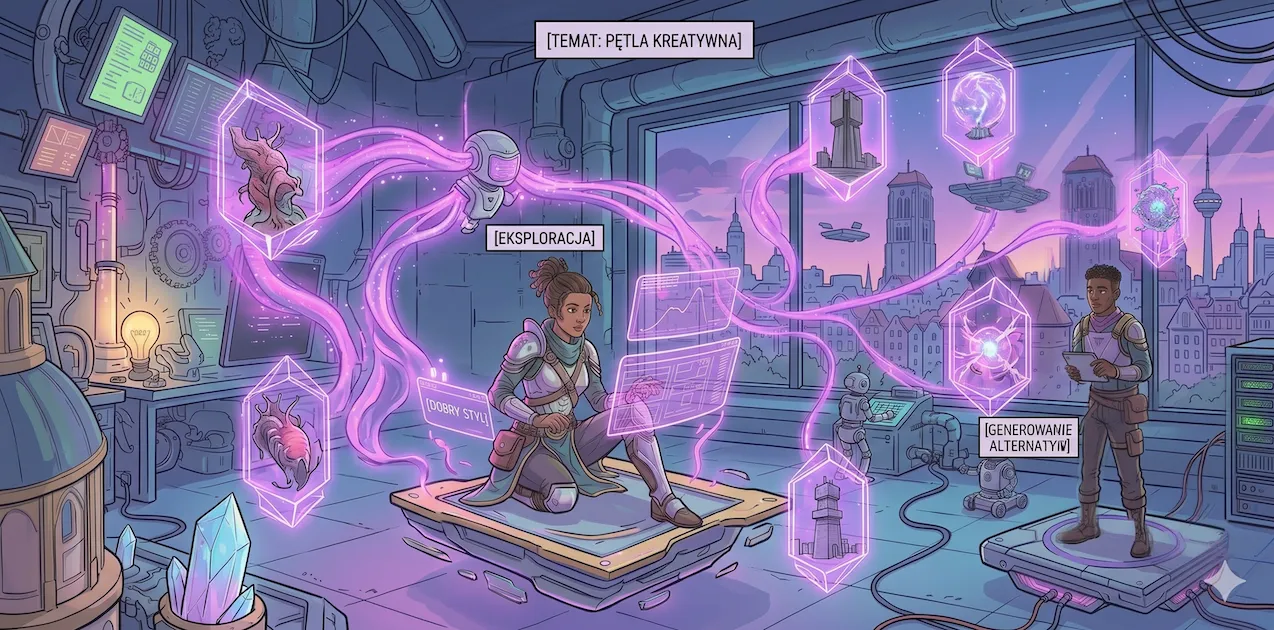
AI as a Tool in the Creative Loop
Leveraging language models to generate alternatives expands horizons and streamlines idea exploration.
The current pace of IT projects demands a lightning-fast transition from problem to solution. Manually brainstorming diverse options and then evaluating them for quality creates a bottleneck during product development.
Many people already accelerate this alternative-generation phase by leveraging language models to instantly spark ideas from various angles. This approach expands horizons and simplifies exploring concepts that would have previously swallowed much more of our time. It is crucial to define the number and abstraction level of the outputs for the model, and to always “manually” verify that they hold true. Of course, nothing stops us from pushing automation a step further. Where feasible, it is highly efficient to subject initial concepts to a “statistical quality assessment” before reviewing them manually, saving energy that would otherwise be wasted on sifting through dozens of mediocre options.
The simplest example prompt to guide the model through this exercise:
Based on the specification [...], prepare 5 implementation ideas.
Vary the approach regarding the costs and time required for each solution.
Recommend one of the presented ideas and justify your choice.
Then, follow up-perhaps even utilizing a language model with a different specialization or focus:
Based on the presented ideas, assess their statistical probability of success.
Take into account projected market volatility and the ongoing AI revolution.
It is well worth running this exercise twice-once manually and once with AI-and then comparing both the time spent and the quality of the solutions. If the generated ideas fall short, we likely fed the LLM poor context or lacked detail. Conversely, if your manual process turns out to be faster, you are almost certainly doing something wrong.
Paweł Nejczew