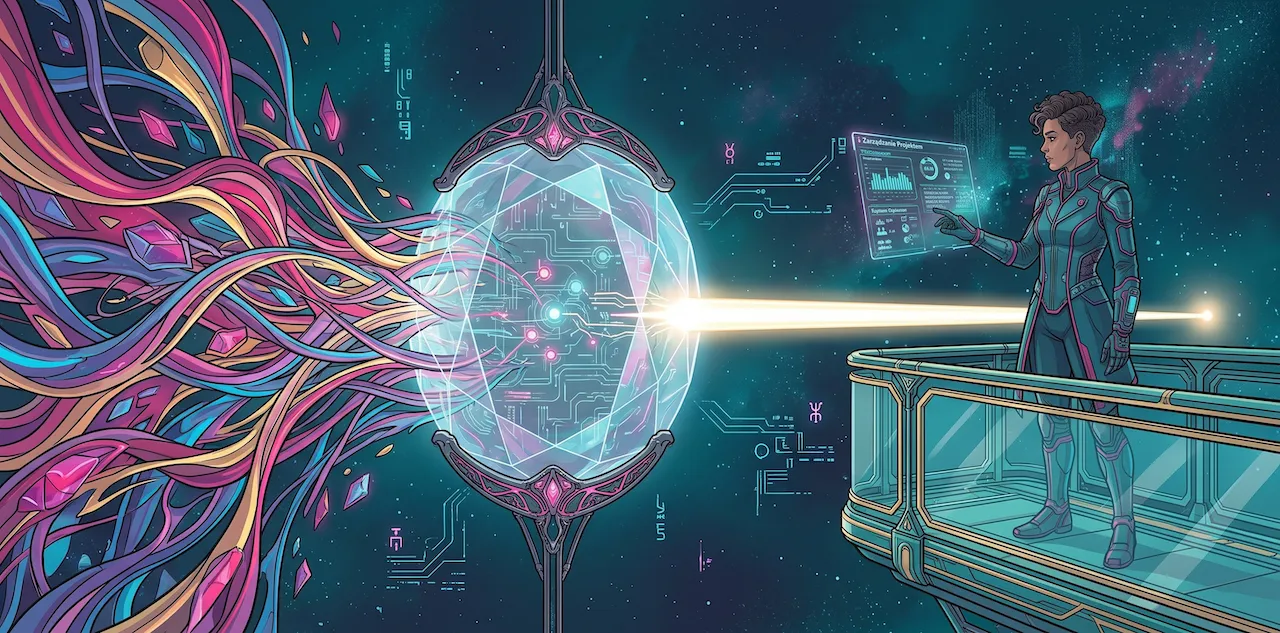
Divergent and Convergent Thinking Through the Lens of IT and AI
In this article, I analyze the mechanisms of divergent and convergent thinking in the work of IT leaders. I show how to practically combine the generative and analytical phases, how to consciously implement Generative AI into the creative process, and how to avoid the pitfalls of statistical models without losing human intuition and critical thinking.
Over the years, I’ve realized that my nature makes doing my job harder. On a daily basis, it’s difficult to combine curiosity and exploratory thinking with the role of a Leader. In many cases, this role requires making decisions here and now, without the luxury of asking: “What if?”. Usually, there simply isn’t time for that. Today, AI helps, but it doesn’t always make this task easier either.
Many concepts and theories of thinking have emerged, attempting to explain and categorize the processes happening inside our heads. I operate on the assumption that if we want to unlock greater potential and map out a plan for further action, we first need to understand the underlying mechanism and answer the question: “Why does it work this way, and not another?”.
How Do We Think?
American psychologist Joy P. Guilford, who researched the mechanisms underlying human intelligence, introduced a key distinction in the 1950s between two modes of thinking. Divergent thinking is a creative process focused on viewing a problem from multiple angles and generating many perspectives and ideas. It requires spontaneity and ingenuity, leading to non-obvious and sometimes innovative solutions. This is the moment when we think outside the box and experience breakthroughs. The second mode, convergent thinking, is an analytical approach. It demands clarity, logic, and precision. It’s at this stage that we choose from the available options, weighing what is likely to work versus what is doomed to fail. Ideally, we rely on hard data and predictable outcomes. Unfortunately, however, we often fall victim to cognitive biases - those moments when something feels true to us, but isn’t.
In our daily lives, when faced with a decision, we look for analogies in our memory to past situations. We scan familiar solutions and quickly pick one that worked before, without overthinking. This thought process is algorithmic and schematic, and it is computationally cheap for our brain. It’s not laziness; it’s simply our default setting. We make countless routine decisions throughout the day, so to conserve cognitive bandwidth, we rely on easily accessible mental models built from past experience.
Not everything is a carbon copy, though. Sometimes we encounter a problem for which we have no pre-stored recipe, or we simply want to break away from routine. That’s when we tap into creativity and abstract thinking. We search for alternatives and generate less predictable, status-quo-shattering answers. Depending on the situation and available bandwidth, we adopt different viewpoints. We construct a set of viable solutions based on our social conditioning, risk tolerance, empathy, morality, and many other factors - everything that shapes us over the years, multiplied by our current context. Later, we run a mental simulation of each scenario and its expected outcome, and if one proves convincing, we put it into action.
It might sound a bit grand, but it naturally brings to mind the quote attributed to Albert Einstein: “Insanity is doing the same thing over and over again and expecting different results.” This popular maxim illustrates the flaw of relying solely on existing templates and encourages us to activate the creative process. It highlights that if we want different results, we must find an alternative way of acting, which sometimes means changing the parameters guiding our decisions.
Do We Use Both Modes When Trying to “Figure Something Out”?
Yes, they are usually inseparable, and we alternate between the generative phase and the exploratory phase. This approach to the creative process is described by the “Geneplore” model - a concept developed by Ronald Finke, Thomas Ward, and Steven Smith in 1992. It distinguishes between two phases: gene(rative) and plore (exploratory). During the first phase, the mind retrieves knowledge from memory, creating associations and analogies to construct raw, abstract preinventive structures - often on a subconscious level. In the second phase, we interpret and analyze these ideas for utility and meaning. We evaluate hypotheses, test their constraints, and draw preliminary conclusions. If we don’t find a satisfactory solution, we return to the generative phase to modify or build a new mental structure. We operate in a loop: generate – evaluate – select or return to step one.
In adult society, convergent thinking dominates. When learning, we engage more in abstract thinking because we are still discovering how things work and questioning them - sometimes as an experiment, sometimes as part of a natural rebellious phase. However, the educational system and broader society heavily push us toward established templates, rewarding the search for the single correct answer. This stifles creativity in favor of standardizing how we think; some fight this system and stand out from the crowd over time. On the flip side, seasoned experts in their fields rarely get derailed by random ideas or mind-wandering. They approach unproven concepts faster and with a critical eye, effectively filtering them out before deeper exploration. They efficiently audit mental structures using their theoretical knowledge and hands-on experience.
Do We All Think the Same Way?
We may have a naturally innate preference for a specific cognitive style. According to Michael Kirton’s KAI (Kirton Adaption-Innovation) theory, people approach problem-solving differently, falling into two main profiles: Adaptors and Innovators. While this isn’t identical to Joy P. Guilford’s framework, there are clear parallels. Adaptors operate within established, structured systems, refining solutions from inside existing frameworks - exhibiting traits of convergent thinking. Innovators, on the other hand, challenge existing mechanisms and look for unconventional solutions outside established rules - much like divergent thinkers.
What contrasts the two theories is the fixed preference for accepting or challenging a given structure. Under KAI theory, structure is a safe space for continuous improvement for some, and a limitation for others. In Guilford’s creative process model, however, both divergent and convergent phases occur sequentially and are indispensable. According to Kirton’s research, society doesn’t split neatly into a binary division of Innovators and Adaptors. The majority of the population lies near the center of the spectrum, following a normal distribution (a Gaussian bell curve). Most of us exhibit slight to moderate preferences toward one strategy. Drawing parallels between these theories suggests that the vast majority of people can switch between both phases of creative thinking with similar effort.
Looking at Gallup strengths (CliftonStrengths), certain themes clearly point to a natural predisposition toward one phase of thinking, pulling specific individuals away from the statistical center of cognitive preferences. For example, themes like Futuristic, Strategic, and Ideation rapidly synthesize loose ends, generating three alternative solutions and five answers to “what if?” with ease. Conversely, those leaning heavily toward themes like Deliberative, Restorative, and Analytical probe for concrete facts, demand proof, spot logical flaws, and urge caution to mitigate risk. But remember: this is merely an innate preference driven by natural talents, not an inability to think in the “other” phase. Still, we see storytellers who thrive in the group’s spotlight, alongside people who look like they chose an abacus over a scooter in early childhood.
Statistically, mid-level managers spend 40–70% of their time thinking convergently. At this level, generating ideas is usually relevant only at the start of a project or during long-term strategic planning. After that, the work becomes far more systematic and linear. They analyze ideas brought by the team, explore potential solutions, weigh risks, and make calls. So, does a naturally “turbocharged” generative phase disqualify someone from a management role? No, but it definitely doesn’t make life easier. It’s crucial to recognize this tendency, identify personal biases, and enforce time or volume limits on generating alternatives. A great example is Dan Martell’s “1-3-1” rule: 1 problem, max 3 solutions, 1 recommendation/decision. This structured thinking caps the generative phase, leaving a lean set of options for final evaluation. The pre-selection stage remains only “moderately convergent,” leaving 3 viable paths for the ultimate decision.
For a “Strategic / Ideation” Manager, strictly adhering to constraints is essential to becoming decisive and driving execution. That’s what their team expects. There is no time for endless philosophizing or speculation. Hesitation kills momentum and stalls the broader team organization.
How to Break Out of the Creativity Loop?
We clearly need both cognitive mechanisms to close the loop on the creative process. Even the longest generative phase - almost bordering on daydreaming - eventually requires a mode switch and a conclusion. Otherwise, it leads to a pile of abstractions, sketches, and loose thoughts that go nowhere. Conversely, an overextended exploratory phase drains the pool of ideas available for analysis and evaluation, resulting in low innovation or, worse, compromised quality standards. The key is striking the right balance for the situation or establishing clear guardrails that force a methodical shift between modes.
We achieve the best results by skillfully combining both stages of the creative process. Naturally and subconsciously, we alternate between generating and analyzing ideas. Yet, sometimes we get stuck in the creative-decision loop, continuously generating new ideas or failing to pass any existing solution through our logical filter. There are several proven ways to break out of this paralysis and move work forward. It pays to have a few of these techniques in your toolkit so you can apply the right one to the situation at hand.
The simplest and most intuitive method is verbal. Guided by someone else or through self-talk, we use common reality checks: “you can never be 100% sure,” “don’t overthink it,” or “there’s no time for what-ifs.” In the opposite scenario - when we or our team approach a problem too superficially without exploring full potential - we prompt: “think it through again,” “there must be a better way to solve this,” or “put yourself in customer XY’s shoes.” Each phrase serves a specific purpose, targeting a distinct stage of the thought process. Some adjust the bar for acceptance, while others ignite or temper creativity. Their impact depends heavily on the emotional tone and delivery. The key is identifying where the bottleneck lies and using a targeted catalyst phrase suited to the context and person.
Enforcing time or output limits works well for effective processes that tend to drag on. It helps when time is tight or when you need to cap the number of ideas moving into analysis. The 3/1 method (three alternatives, one recommendation) excels here - especially when pitching solutions across decision-making levels. It effectively presents stakeholders with both the creative phase (3 options) and the analytical outcome (1 recommendation). This rule is equally effective as a prompt framework for AI models, structuring LLMs to return broad context alongside a tailored solution.
For teams tackling a shared creative challenge, I recommend a classic: the Walt Disney Method. It involves looking at a problem from three distinct angles: The Dreamer, The Realist, and The Critic. First, let imagination run wild without judgment or critique. Next, objectively analyze feasibility - don’t shoot ideas down, find ways to make them work. Finally, apply a critical lens to spot risks and vulnerabilities, making the concept bulletproof. Ideas are discarded only at the very end if they fail critical scrutiny or cannot be resolved through feedback loops - sending fixes back to the Realist to adjust constraints or to the Dreamer to pivot the vision. For a leader, the hardest part is curbing the team’s knee-jerk impulse to criticize new ideas prematurely, protecting the creative output of less outspoken team members.
It’s worth experimenting with these techniques and adapting them as needed. Changing physical location or working environment can also help separate process stages. Environmental factors and ergonomic comfort directly influence mindset; shifting surroundings is particularly effective during multi-stage framework sessions.
What Happens Between Problem and Solution in IT Engineering?
Unsurprisingly, actions need to be designed and executed. While formal frameworks and structured methodologies can kickstart or organize discussions, a common approach in IT boils down to two quick stages: “whiteboard,” followed by “let’s build it and see.” This translates to generating ideas on a whiteboard (or paper), running a quick theoretical sanity check, and diving straight into practical exploration - commonly known as “we’ll code it up and test if it works.” In short: ideate possible approaches, then experiment until finding what fits.
On the surface, this might seem illogical - why not fully design the architecture before building? In the fast-changing world of modern IT, relying strictly on legacy blueprints would be rigid, uninspired, and often impossible. Implementing last year’s pattern might prove far more costly and time-consuming than leveraging current tools. Most technological innovations aim to boost efficiency, automate tedious tasks, and push performance or security boundaries. That said, balance is everything. The larger the enterprise initiative, the less you should rely on unproven tech trends. Solid, anti-fragile foundations are essential for building reliable systems that last for years. Startups and targeted experiments demand a different risk posture; here, modern tech stacks are often key to success, provided fast, low-cost pivots remain possible when an experimental stack fails to deliver.
Since all of it feel unpredictable and undeterministic, it begs the question: can you reliably plan anything ahead of time in software engineering? Depending on the initiative, estimates account for risk through buffer margins - a standard practice across project delivery. While exploring new tools must be controlled, exploration itself will never disappear. Great engineers continuously expand their skills, adopting new frameworks to build faster, safer, and scalable systems. Here, cadence is driven by rapid technological progress and evolving industry standards.
The answer to “How do we plan?” lies in agile methodologies. We work iteratively, regularly reviewing working software and prototypes. This approach enables step-by-step progress verification and allows requirements to adapt before final delivery. Under this model, we accept that the end product may evolve beyond initial assumptions - aligning with live market demands rather than static day-one specs. Yes, this demands continuous alignment between product vision and engineering execution. And yes, while this leads to shifting scope during execution, it ultimately yields a superior outcome. This dynamic reinforces that creative problem-solving has increased - every requirement shift triggers fresh options to explore and validate. That’s why cultivating dedicated space for creative thinking, analysis, and hands-on experimentation is essential.
Does Generative AI Help or Hinder?
In the ongoing AI revolution, the primary variable being compressed is time. We can accomplish more, faster - a distinct advantage given today’s pace of business. With a well-crafted prompt, we can instantly generate dozens of viable approaches for review. Once we have a candidate list, we can feed it back into an AI model for rapid stress-testing and statistical evaluation. Automating parts of the ideation-analysis loop saves immense time, particularly during early technical scoping and prototyping.
Large language models excel at transcribing meetings, summarizing key points, and distilling the underlying narrative. From there, a properly configured AI Agent can automatically audit the resulting ideas or generate tasks for the team to review manually. Next, another automated AI step can gather these results and package them into an easily digestible presentation format, tailored to the audience and tone. The time saved by transforming text and the information within it is one of the first tangible benefits this new technology offered - and one of the first we successfully integrated into our daily workflow.
However, relying on AI introduces familiar traps, akin to blindly trusting early web search results. The conversational interface of LLMs leads us to anthropomorphize them as domain experts, falling for their confident tone. Years ago, people warned: “don’t trust open wikis; anyone can edit them.” Yesterday, the caution was against self-proclaimed social media gurus. Today, the same skepticism applies to AI: “Who trained this model, and is it hallucinating?” Experienced practitioners learned to verify web sources and evaluate quality critically. Despite time pressures and data noise, maintaining discipline to validate all LLM outputs remains non-negotiable.
So Why Hasn’t AI Replaced Us Yet?
Today, you can throw a brief prompt at AI and it will magically generate a candidate solution or even a working mini-project. This isn’t theory - it’s reality, and many managers in early hype stages are already recalculating cost savings. But let’s cool off expectations, because that’s where the hidden trade-offs start. LLMs and AI agents produce impressive outputs, but out-of-the-box responses generated from basic prompts are mediocre at best. They are certainly faster than manual search queries or digging through tech forums. They condense vast information efficiently, but unless carefully tuned, their outputs default to average, statistically predictable patterns. That’s fine - provided we recognize this baseline and use the tools consciously.
Language models construct answers based on what they have previously learned and what is statistically probable. Building - or training - them consists of several stages. First, vast amounts of data are gathered, such as texts, books, articles, infographics, or application source code. These collections are processed to split the information into parts, analyzing and recording the relationships between them. A map of probabilities is built to show which sequences of information fragments are likely to follow one another. Next, on smaller, specialized datasets, these connections are reinforced to fine-tune the model for a specific field. An LLM prepared this way far better meets the targeted expectations of its creators and end users.
Here lies the core architectural bottleneck of modern AI tools: LLMs do not reason through cause-and-effect logic (if-this-then-that); they predict the most probable sequence completion based on user input. The algorithm navigates a vast mathematical vector space to pick the most expected response. Prompt engineering simply narrows the context space used to calculate outputs. Again, “optimal” outputs are defined statistically during training. Moving beyond mediocrity requires advanced prompting skills, system context, structured role definitions, and curated domain inputs. While AI speeds up routine tasks, creative engineering still requires human oversight to turn generic outputs into robust, production-grade architecture.
By fine-tuning how the model algorithm behaves, you can adjust response determinism and move past the default ‘give-me-only-the-top-statistical-answer’ rule. You can guide an LLM to meet your expectations far better by framing the right context, crafting well-structured prompts, defining clear operational roles, and providing problem-specific input data. Ultimately, despite AI’s undeniable breakthrough nature, extracting true value beyond mediocrity demands additional skill. For repetitive tasks, defaults might suffice; but in creative endeavors, AI serves primarily as a process catalyst - or an eye-opener to options previously obscured by the time required to gather them.
Conclusions
When we grasp the mechanisms behind creative thinking and acknowledge different individual predispositions and the ease with which certain people operate across process phases, we realize there is no single silver bullet that unlocks every door to success. Factoring in the relentless evolution of our working environment, taking reckless shortcuts - dictated by enthusiasts at the first stage of the Dunning-Kruger effect (those who don’t know how much they don’t know yet) - is irresponsible engineering. We shouldn’t resist or ignore progress, but we must accept tool mechanics and limitations that could compromise the quality of the solutions we build.
Sci-fi writer Arthur C. Clarke’s Third Law states: “Any sufficiently advanced technology is indistinguishable from magic.” Precisely because it isn’t magic, but simply advanced tooling, we need to understand how it works and use it accordingly. We are already shifting from mere executors to architects of constraints, and it is up to us how much of our work we delegate to AI models. Optimization - especially of creative processes - is incredibly complex, demanding our unquantifiable intuition in many places, and sometimes even a willingness to make risky, often irreversible decisions. Such actions lie outside the center of the normal distribution curve; they are neither statistically the most popular nor always a guarantee of success, yet they are what drive breakthroughs and uniqueness. The current hype and our cognitive biases have already formed such a massive snowball of AI popularity that we ought to let it melt a bit and, paradoxically, with a cool head, carve out the right space for these tools. I emphasize the word: tools.
New opportunities are emerging to complement human cognitive strengths and limitations. Beyond self-discipline, we can now configure an artificial augmentation layer to bypass creative and technical bottlenecks. We have a clear opportunity to accelerate delivery and scale impact - provided we avoid complacency across design phases and thoughtfully combine human intuition with digital automation.
Paweł Nejczew